

Craft Vodka Market Set to Reach USD 11.68 Billion by 2035 as Premium Spirits Gain Momentum
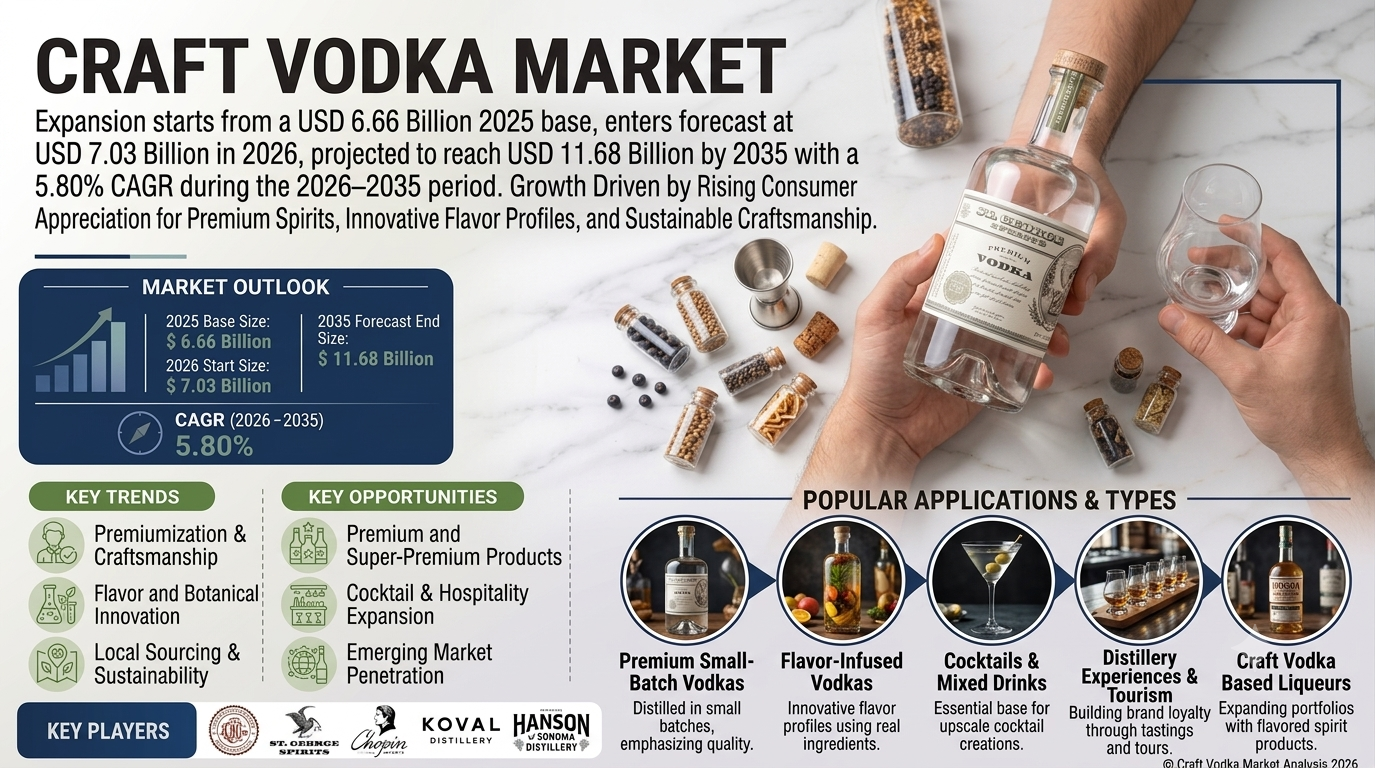
Craft Vodka Market
Global Craft Vodka Market to Grow at 5.80% CAGR Through 2035, Driven by Premiumization, Innovation, Direct Sales and Distillery Experiences.
Craft vodka is evolving through premium craftsmanship, distinctive flavors, and authentic consumer experiences, creating new opportunities for producers worldwide.”
NEW YORK, NY, UNITED STATES, September 1, 2026 /EINPresswire.com/ -- The global Craft Vodka Market is entering a period of steady transformation as consumers increasingly seek spirits that offer distinctive production methods, recognizable provenance, premium positioning, and stronger connections with producers. Craft vodka is moving beyond its traditional role as a neutral cocktail base as independent distillers experiment with raw materials, botanical infusions, production techniques, sustainability practices, and experiential retail. According to the latest market assessment, the industry was valued at USD 6.66 billion in 2025 and is expected to reach USD 11.68 billion by 2035, representing a 5.80% CAGR from 2026 to 2035. The market is projected to reach approximately USD 7.03 billion in 2026.— Market Research Future (MRFR)
The evolution of the category reflects a broader shift in beverage preferences. Consumers are becoming more interested in products with an identifiable origin and production story, while bartenders and hospitality operators are looking for spirits that can contribute distinctive characteristics to cocktail programs. Small and independent distilleries are responding by developing differentiated products around local ingredients, small-batch processes, organic sourcing, alternative grains, potatoes, grapes, whey, honey, and other substrates. This combination of product differentiation and premium positioning is creating additional avenues for craft vodka producers to establish themselves in an increasingly competitive spirits environment.
Market Growth:
Premiumization remains one of the most important forces shaping the Craft Vodka Market. Instead of competing primarily through volume and low prices, craft producers generally emphasize quality, production transparency, ingredient selection, regional identity, and limited availability. These characteristics allow brands to target consumers who are willing to pay more for a product that provides a differentiated experience.
Premium vodka is particularly well positioned within cocktail culture because consumers increasingly associate higher-quality spirits with sophisticated drinking occasions. Craft producers can reinforce this positioning through distinctive packaging, transparent production narratives, tasting experiences, and bartender partnerships. The premium category is identified as the fastest-growing category segment, with a projected 7.61% CAGR between 2026 and 2035.
Premiumization also changes how distilleries approach product development. Rather than introducing large numbers of conventional expressions, producers can develop limited releases, single-source products, estate-based spirits, or special botanical variations. These offerings create opportunities to build stronger consumer engagement while supporting higher-value transactions.
Craft Vodka Market Segmentation:
The Craft Vodka Market is segmented by product type, raw material, end user, category, and distribution channel, with differentiation driven by ingredients, craftsmanship, positioning, and consumer preferences.
By Product Type:
Non-flavored vodka dominated with a 79.5% share in 2025, supported by its versatility as a cocktail base. Flavored vodka is expected to grow at a 6.26% CAGR through 2035, driven by fruit, botanical, and innovative flavor combinations.
By Raw Material:
Grain-based vodka led with USD 4.31 billion in 2025, benefiting from efficient production and established supply networks. Potato-based vodka held a 17.9% share, while alternative raw materials are gaining attention through sustainability and product differentiation.
By End User:
Men accounted for 64.6% share in 2025, representing the largest consumer segment. The women segment is projected to expand at a 6.98% CAGR, supported by cocktail-oriented products and evolving consumer preferences.
By Category:
Mass products generated USD 3.63 billion in 2025, supported by accessibility and broad distribution. Premium vodka is expected to grow at a 7.61% CAGR, driven by premiumization, gifting, and consumers trading up.
By Distribution Channel:
Off-trade accounted for 80.6% share in 2025, supported by retail availability and home consumption. On-trade is projected to grow at a 6.06% CAGR, fueled by hospitality recovery and greater use of craft vodka in cocktails.
Grain-Based Vodka Retains a Strong Position:
Raw material selection remains another important source of differentiation. Grain-based vodka represents the largest raw-material segment, supported by the established availability of wheat, rye, corn, and other grains. The segment generated approximately USD 4.31 billion in 2025, according to the report.
Grain provides producers with dependable sourcing and production characteristics. At the same time, the choice of grain can contribute to a brand's identity, particularly when producers use locally sourced or single-origin ingredients.
Potato-based vodka represents another established segment, with a strong association with European production traditions. Alternative raw materials are also becoming more prominent as producers search for distinctive flavor profiles and sustainability opportunities.
Whey, grapes, honey, cassava, and other unconventional substrates can provide craft brands with unique stories while supporting the utilization of agricultural or food-production by-products. The report identifies the alternative raw-material segment as a fast-growing area, reflecting the increasing emphasis on experimentation and circular production concepts.
Distribution Strategies Are Changing
Distribution remains one of the most important strategic considerations for independent vodka producers. Traditional retail distribution provides access to a broad customer base, but it can also involve multiple layers between producer and consumer.
Direct-to-consumer channels provide craft brands with an alternative route to customers where regulations permit. Online sales, distillery memberships, tasting-room purchases, and producer-led experiences can strengthen relationships while giving businesses greater control over brand presentation.
The development of direct channels is especially valuable for smaller distilleries because the customer relationship extends beyond a single bottle purchase. Producers can collect insights into customer preferences, develop membership programs, introduce seasonal releases, and encourage repeat purchases.
At the same time, retail remains essential for building visibility. Successful craft vodka companies are therefore increasingly balancing off-trade retail distribution with hospitality, tasting rooms, digital engagement, and direct sales.
Get Full PDF Sample Copy of Report: (Including Full TOC, List of Tables & Figures, Chart) @
https://www.marketresearchfuture.com/sample_request/26762
Competitive Environment:
The competitive structure of the Craft Vodka Market remains fragmented, with independent producers competing alongside larger spirits organizations and established craft brands.
▪️Fifth Generation
▪️St. George Spirits
▪️Chopin Imports
▪️KOVAL Distillery
▪️and Hanson of Sonoma
▪️Hanson of Sonoma Distillery
▪️KOVAL Distillery
▪️Death's Door Spirits
▪️Dry Fly Distilling
▪️Journeyman Distillery
Competition is increasingly based on brand identity rather than price alone. Producers are differentiating themselves through raw material selection, organic credentials, regional sourcing, production techniques, packaging, tasting experiences, and cocktail partnerships.
Fifth Generation has built significant recognition around its vodka brand while retaining an independent craft-oriented identity. St. George Spirits emphasizes technical experimentation and distinctive expressions. Chopin Imports benefits from single-ingredient positioning and Polish heritage. KOVAL combines organic and certification-based positioning with alternative grain usage, while Hanson of Sonoma highlights grape-based production and organic attributes.
The competitive landscape also creates opportunities for smaller entrants. Because craft vodka consumers often seek uniqueness, a new producer does not necessarily need national scale to establish a viable brand. Strong regional positioning, hospitality relationships, and direct customer engagement can provide a foundation for expansion.
On-Trade Demand Supports Craft Vodka Discovery:
The on-trade channel is gaining importance as cocktail culture continues to influence spirits consumption. Bars, hotels, restaurants, lounges, and specialty cocktail venues provide consumers with an opportunity to discover unfamiliar vodka brands in an experiential setting.
The on-trade segment is expected to expand at a 6.06% CAGR from 2026 to 2035. Bartenders play a particularly important role because recommendations from experienced mixologists can influence consumer perceptions of quality and encourage trial.
Craft vodka brands can benefit from partnerships with cocktail bars by providing tasting sessions, education, menu collaborations, and limited-release products. Such partnerships can establish credibility that is difficult to achieve through conventional advertising alone.
For emerging brands entering new countries, hospitality venues may also provide a more efficient entry point than immediate mass retail expansion. Consumers can experience the product first, understand its positioning, and subsequently seek it out through retail or online channels where available.
News & Developments:
▪️UK Treasury (2023): Introduced Small Producer Relief, reducing effective alcohol duty for eligible small distillers and supporting cash flow.
▪️Dubai Government (2023): Suspended the 30% alcohol sales tax and waived personal licence fees, supporting hospitality activity.
▪️Kentucky General Assembly (2023): Expanded direct-to-consumer shipping and by-the-drink privileges for licensed distilleries.
▪️St. George Spirits (2024): Launched a limited vodka series made with single-farm California grain, highlighting provenance-focused premiumization.
▪️European Commission (2024): Advanced guidance on ingredient and nutrition labeling for spirit drinks, strengthening transparency requirements.
▪️American Craft Spirits Association (2024): Reported continued growth in the U.S. craft distilling sector, supporting opportunities for independent vodka producers.
▪️Constellation Brands (2024): Continued its focus on higher-priced spirits, reflecting growing interest in premium categories.
▪️Australian Taxation Office (2025): Maintained expanded excise relief for eligible small distillers, supporting the domestic craft spirits sector.
Regional Landscape:
North America remains a major center for craft vodka, accounting for approximately 35.8% of global revenue in 2025. The region benefits from a well-established independent distilling ecosystem, tasting-room culture, developed retail infrastructure, and increasing consumer interest in direct producer relationships. The United States is the largest contributor, with independent distilleries building localized brands around regional ingredients, distinctive production identities, and authentic storytelling. Europe is expected to record the fastest regional expansion, with a projected 8.02% CAGR through 2035, supported by strong spirits traditions, distillery tourism, cocktail culture, sustainability awareness, and rising interest in provenance. Opportunities are emerging for potato-based, grain-based, organic, and alternative-substrate vodka, allowing producers to differentiate through geographic identity and traditional production practices.
Asia-Pacific is another promising region, with the market generating approximately USD 1.37 billion in 2025. Demand is supported by premium hospitality, tourism, cocktail culture, and growing interest in international spirits across Japan, South Korea, China, India, and Australia. South America is also developing opportunities through cocktail-bar expansion and locally sourced ingredients, with Brazil representing an important market alongside Argentina and other emerging destinations. Meanwhile, the Middle East and Africa offer opportunities through hospitality, tourism, travel retail, and premium hotel channels. South Africa's independent distilling community and major hospitality hubs provide additional potential for premium regional and international craft vodka brands.
Sustainability Becomes More Important:
Environmental considerations are becoming increasingly relevant throughout the spirits supply chain. Consumers, retailers, and hospitality businesses are paying greater attention to ingredient sourcing, packaging, energy consumption, water use, and transportation.
Craft distilleries can use sustainability as a practical differentiator by sourcing ingredients locally, reducing packaging weight, recovering heat during production, improving water efficiency, or incorporating renewable energy.
Alternative raw materials can also contribute to sustainability narratives when producers transform agricultural or food-processing by-products into usable fermentation inputs. Such practices can provide both environmental and commercial value when they are supported by transparent sourcing information.
Sustainability, however, is becoming more than a branding message. Retailers and business partners are increasingly interested in evidence behind environmental claims. Producers that document their sourcing and production processes will be better positioned to respond to these expectations.
Traceability Strengthens Consumer Trust:
Traceability is expected to become a central part of craft spirits positioning. Consumers increasingly want to understand where ingredients come from, while retailers and regulators are placing greater emphasis on accurate product information.
Digital production records can allow distillers to track raw materials, fermentation characteristics, distillation stages, filtration, and bottling information. These systems can support quality control while giving producers credible information to communicate to customers.
For craft vodka, traceability can also reinforce the core value proposition. A producer that can demonstrate the origin of its grain, explain its production method, and connect a finished bottle with a particular batch can create a stronger sense of authenticity.
Key Challenges Facing Producers:
Despite favorable opportunities, craft vodka producers face several structural challenges. Competition for retail shelf space remains intense, particularly as global brands possess significant distribution capabilities and marketing resources.
Input costs can also place pressure on independent distilleries. Glass bottles, closures, grain, energy, transportation, and packaging materials represent important operating expenses. Smaller businesses may have less purchasing power than large spirits companies, making cost management particularly important.
Regulatory requirements add another layer of complexity. Alcohol licensing, labeling, advertising restrictions, excise structures, and distribution rules vary substantially between countries and, in some cases, between states or provinces.
These conditions mean that craft vodka companies must combine product creativity with disciplined operational management. A distinctive product alone may not be sufficient if production costs, distribution arrangements, or regulatory compliance are not properly managed.
Future Outlook:
The outlook for the Craft Vodka Market remains positive as premiumization, product experimentation, hospitality demand, and growing consumer interest in authenticity continue to influence the industry. Between 2026 and 2035, the market is expected to advance from approximately USD 7.03 billion to USD 11.68 billion, reflecting a 5.80% CAGR. Opportunities are emerging across premium vodka, flavored expressions, alternative raw materials, on-trade applications, and regions with rising interest in premium spirits. Producers are increasingly focusing on quality, distinctive craftsmanship, transparent sourcing, and innovative production methods to differentiate their offerings and strengthen consumer loyalty.
The next phase of the Craft Vodka Market is expected to emphasize experiences alongside product quality. Distilleries can increasingly serve as destinations, while signature cocktails, limited releases, direct sales, and membership programs can create deeper consumer engagement. Digital traceability and data-driven marketing may further strengthen connections between independent producers and their audiences. Sustainability, responsible production, authentic brand storytelling, and modern distribution will also remain important competitive factors. Overall, craft vodka is evolving from a niche spirits segment into a sophisticated premium category, with long-term success likely to favor producers that combine craftsmanship, innovation, sustainability, and memorable consumer experiences.
Frequently Asked Questions?
1. What is driving the Craft Vodka Market?
Premiumization, cocktail culture, innovative ingredients, direct-to-consumer opportunities, tasting-room experiences, and growing consumer interest in provenance are major factors supporting the market.
2. Which Craft Vodka segment is growing fastest?
The premium category is projected to be among the fastest-growing segments, with a 7.61% CAGR during 2026–2035. Europe and the women end-user segment are also identified as high-growth areas.
3. What raw materials are used to produce craft vodka?
Craft vodka can be produced from grains such as wheat, rye, and corn, as well as potatoes and alternative materials including grapes, whey, honey, and cassava.
4. What is the projected size of the Craft Vodka Market by 2035?
The global Craft Vodka Market is projected to reach USD 11.68 billion by 2035, expanding at a 5.80% CAGR during the forecast period.
Browse More Reports:
Fruit Beer Market:
https://www.marketresearchfuture.com/reports/fruit-beer-market-6315
Bee Pollen Market:
https://www.marketresearchfuture.com/reports/bee-pollen-market-31899
Ale Beer Market:
https://www.marketresearchfuture.com/reports/ale-beer-market-24305
Draught Beer Market:
https://www.marketresearchfuture.com/reports/draught-beer-market-32182
Market Research Future
Market Research Future
+1 855-661-4441
email us here
Legal Disclaimer:
EIN Presswire provides this news content "as is" without warranty of any kind. We do not accept any responsibility or liability for the accuracy, content, images, videos, licenses, completeness, legality, or reliability of the information contained in this article. If you have any complaints or copyright issues related to this article, kindly contact the author above.
