

Jerky Market Set to Sizzle at 6.04% CAGR, Reaching USD 9.171 Billion by 2035 on High-Protein Snacking Demand
Jerky Market
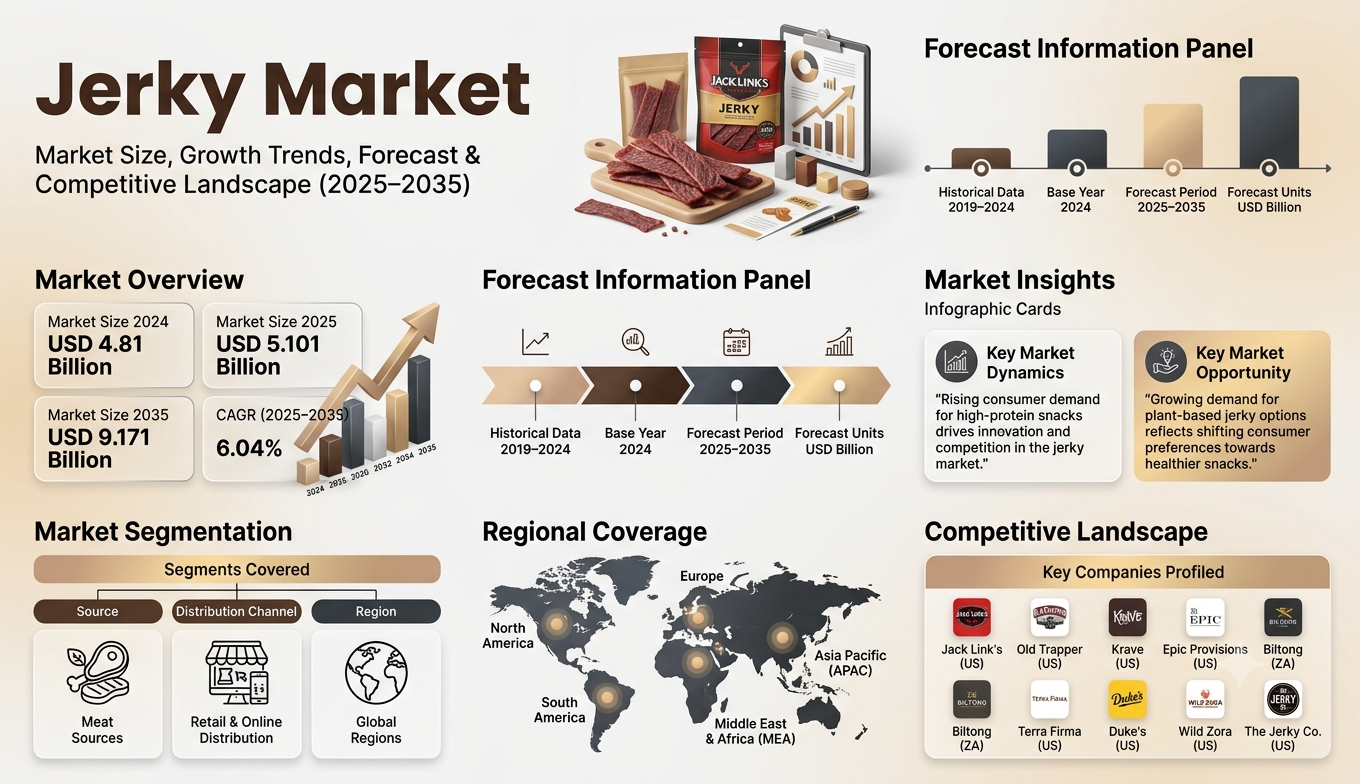
The global jerky market, valued at USD 5.101 billion in 2025, is projected to reach USD 9.171 billion by 2035, growing at a 6.04% CAGR.
NEW YORK, NY, UNITED STATES, July 8, 2026 /EINPresswire.com/ --Jerky Market is experiencing a robust transformation as consumers increasingly gravitate toward convenient, shelf-stable, protein-rich snacking options. Valued at USD 4.81 billion in 2024, the market is estimated to reach USD 5.101 billion in 2025 and is projected to expand significantly to USD 9.171 billion by 2035, registering a compound annual growth rate (CAGR) of 6.04% during the forecast period of 2025 to 2035. This growth trajectory reflects a broader shift in global dietary patterns, where snacking is no longer viewed as an indulgence but as a functional part of daily nutrition. Jerky, traditionally associated with beef and other meat-based preparations, has evolved into a diverse category encompassing plant-based, poultry, and exotic protein variants, catering to a wide spectrum of consumer preferences across geographies and income levels.
The driving force behind this expansion is the rising global demand for high-protein, low-carbohydrate snacks among fitness enthusiasts, busy professionals, and health-conscious millennials and Gen Z consumers. Jerky's long shelf life, portability, and minimal need for refrigeration make it an ideal snack for on-the-go lifestyles, outdoor activities, and travel. Additionally, the increasing popularity of ketogenic, paleo, and high-protein diets has further cemented jerky's position as a preferred snack alternative to sugary or carbohydrate-heavy options. Manufacturers are responding to this demand with innovative flavors, cleaner ingredient labels, and reduced sodium formulations, thereby broadening the product's appeal beyond its traditional consumer base.
Free Sample Copy - Access A Complimentary Copy of Our Report to Explore Its Content and Insights
https://www.marketresearchfuture.com/sample_request/8253
The competitive landscape of the jerky market is characterized by a mix of established heritage brands and emerging niche players competing for shelf space and consumer loyalty. Key companies profiled in this space include Jack Link's (US), a dominant force known for its extensive distribution network and brand recognition; Old Trapper (US), recognized for its traditional smoking techniques; Krave (US), which has carved a niche in premium, artisanal jerky; and Epic Provisions (US), a pioneer in the whole-animal, protein-rich snacking movement. Other notable players include Biltong (ZA), representing the traditional South African dried-meat category gaining global traction; Terra Firma (US); Duke's (US); Wild Zora (US), known for its meat-and-vegetable bar innovations; and The Jerky Co. (US). These companies are actively investing in product diversification, sustainable sourcing, and strategic partnerships to strengthen their market positions amid intensifying competition.
Segmentation by source forms a critical pillar of understanding the jerky market's structure. The market is broadly divided into beef, poultry, pork, and plant-based/other protein sources. Beef jerky continues to dominate the category owing to its established consumer base, rich flavor profile, and widespread availability across retail channels. However, poultry-based jerky, particularly turkey and chicken variants, is witnessing accelerated growth due to its leaner protein content and lower price point compared to beef. Meanwhile, the plant-based jerky segment, though currently a smaller share of the overall market, is emerging as the fastest-growing category. This growth is fueled by rising vegan and flexitarian populations who seek protein-dense snacking alternatives made from soy, jackfruit, mushrooms, and pea protein, without compromising on the chewy texture and savory taste traditionally associated with jerky.
The distribution channel segment further illustrates how consumers are accessing jerky products in an increasingly omnichannel retail environment. Supermarkets and hypermarkets remain the largest distribution channel, offering consumers the advantage of physical product inspection and immediate purchase, along with frequent promotional discounts that drive volume sales. Convenience stores also play a pivotal role, particularly for impulse purchases among commuters and travelers seeking quick, energy-dense snacks. Meanwhile, online retail is emerging as the fastest-growing distribution channel, propelled by the convenience of doorstep delivery, subscription-based snack boxes, and the ability of niche and premium jerky brands to reach a global audience without the overhead costs of physical retail presence. Specialty stores, including health food and outdoor sporting goods retailers, continue to serve as important channels for premium and performance-oriented jerky products.
Regionally, the jerky market demonstrates varied growth dynamics across North America, Europe, Asia-Pacific (APAC), South America, and the Middle East and Africa (MEA). North America remains the largest and most mature market, driven by deep-rooted snacking culture, high disposable incomes, and the presence of major manufacturers such as Jack Link's and Old Trapper. Europe follows as a significant market, with growing interest in protein snacking trends and increasing acceptance of biltong and other traditional dried-meat products. The APAC region is poised to exhibit the fastest growth during the forecast period, attributed to rising urbanization, expanding middle-class populations, and increasing Western dietary influences in countries such as China, India, and Japan. South America and MEA, while currently smaller markets, present untapped growth potential owing to traditional dried-meat consumption practices and increasing modern retail penetration.
Beyond segmentation, the jerky market is being shaped by several overarching trends and opportunities. One of the most significant opportunities lies in the growing demand for plant-based jerky options, reflecting a broader shift in consumer preferences toward healthier and more sustainable snacking choices. This opportunity is particularly pronounced among younger demographics who prioritize environmental sustainability alongside nutritional value. Additionally, clean-label formulations, free from artificial preservatives, nitrates, and excessive sodium, are gaining traction as consumers become more ingredient-conscious. Premiumization is another notable trend, with brands introducing exotic flavors, craft-style preparation methods, and unique protein sources such as venison, salmon, and bison to differentiate themselves in a crowded marketplace.
Despite these positive trends, the market does face certain challenges, including price volatility of raw meat inputs, stringent food safety regulations across regions, and competition from alternative protein snack formats such as protein bars and roasted nuts. Nevertheless, the overall outlook for the jerky market remains strongly positive, supported by sustained consumer interest in functional, protein-forward snacking and continuous innovation from both established and emerging brands.
In conclusion, the jerky market is well-positioned for sustained expansion through 2035, driven by evolving consumer lifestyles, rising health consciousness, and diversification across protein sources and distribution channels. Stakeholders across the value chain, from raw material suppliers to retailers, stand to benefit from the market's steady upward trajectory as jerky continues its transformation from a niche snack into a mainstream global category.
FAQ 1: What is driving the growth of the jerky market between 2025 and 2035?
The market's growth is primarily driven by rising global demand for high-protein, low-carbohydrate snacks, increasing adoption of keto and paleo diets, and growing interest in plant-based jerky alternatives among health-conscious consumers.
FAQ 2: Which region is expected to grow fastest in the jerky market during the forecast period?
The Asia-Pacific (APAC) region is expected to register the fastest growth, fueled by rising urbanization, expanding middle-class populations, and increasing adoption of Western snacking habits.
Read Our Related Research Report
Meat Snacks Market –
https://www.marketresearchfuture.com/reports/meat-snacks-market-4939
Dehydrated Meat Products Market –
https://www.marketresearchfuture.com/reports/dehydrated-meat-products-market-5506
Blended Meat Market –
https://www.marketresearchfuture.com/reports/blended-meat-market-26978
Red Meat Market –
https://www.marketresearchfuture.com/reports/red-meat-market-41885
Processed Meat Market –
https://www.marketresearchfuture.com/reports/processed-meat-market-21730
Sagar Kadam
Market Research Future
+1 628-258-0071
email us here
Legal Disclaimer:
EIN Presswire provides this news content "as is" without warranty of any kind. We do not accept any responsibility or liability for the accuracy, content, images, videos, licenses, completeness, legality, or reliability of the information contained in this article. If you have any complaints or copyright issues related to this article, kindly contact the author above.
