

Cassava Market to Hit USD 312.15 Billion by 2035, Growing at 4.18% CAGR on Gluten-Free Demand
Cassava Market
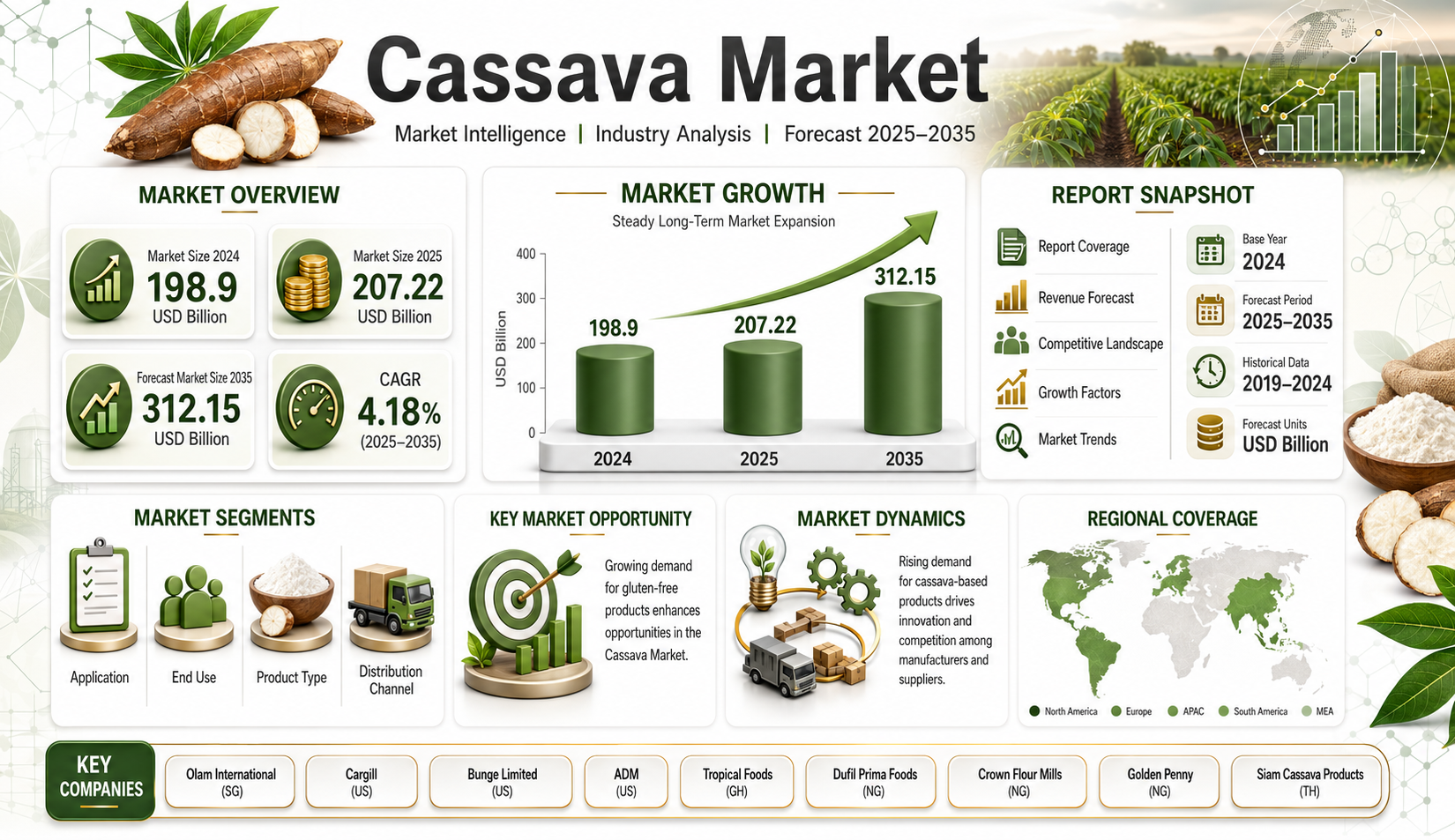
Cassava Market Grew from USD 207.22B (2025) to USD 312.15B by 2035 at 4.18% CAGR, fueled by gluten-free and food security demand.
NEW YORK, NY, UNITED STATES, July 8, 2026 /EINPresswire.com/ --Cassava Market is entering a decade of steady, resilient expansion, positioning the humble root crop as one of the most strategically important commodities in the global food and industrial supply chain. Valued at USD 198.9 billion in 2024, the market is projected to reach USD 207.22 billion in 2025 and climb further to USD 312.15 billion by 2035, registering a compound annual growth rate (CAGR) of 4.18% across the 2025–2035 forecast period. This sustained growth trajectory reflects cassava's expanding role far beyond its traditional identity as a subsistence staple crop across Africa, Asia, and South America.
Cassava's rise is being driven by a powerful convergence of factors: rising global food security concerns, the crop's natural drought tolerance and adaptability to marginal soils, and its growing utility as a raw material across food, feed, pharmaceutical, and industrial applications. Perhaps most significantly, the surging consumer preference for gluten-free products has thrust cassava flour and starch into the spotlight as a premium alternative to wheat-based ingredients, opening entirely new revenue streams for processors and exporters alike.
The competitive landscape of the Cassava Market is shaped by a mix of global agribusiness giants and regional processing specialists who together control sourcing, processing, and distribution across major producing and consuming regions. Olam International (Singapore) and Cargill (US) leverage extensive global supply chain networks to source cassava-derived starches and ingredients at scale, while Bunge Limited (US) and ADM (US) bring deep expertise in agricultural commodity processing and diversified ingredient portfolios that increasingly include cassava-based products.
Regional players are equally critical to market dynamics. Tropical Foods (Ghana) and Dufil Prima Foods (Nigeria) capitalize on proximity to West Africa's massive cassava production base, one of the largest in the world, to serve both local food security needs and export markets. Crown Flour Mills (Nigeria) and Golden Penny (Nigeria) have built strong domestic distribution networks, embedding cassava-based flour and starch products into everyday consumer staples. Meanwhile, Siam Cassava Products (Thailand) anchors Southeast Asia's cassava processing industry, a region renowned for high-yield cultivation and advanced starch extraction technology. Competitive intensity in this space centers on securing consistent raw material supply, investing in processing efficiency, and expanding value-added product lines to capture premium pricing.
Free Sample Copy - Access A Complimentary Copy of Our Report to Explore Its Content and Insights
https://www.marketresearchfuture.com/sample_request/4629
Segmentation by Application: A Diverse and Expanding Utility Base
Cassava's application landscape spans food and beverages, animal feed, pharmaceuticals, textiles, paper, and biofuels. In the food sector, cassava serves as a base for flour, starch, tapioca pearls, and fermented products like garri and fufu that remain dietary staples across large populations. In animal feed, cassava chips and pellets offer a cost-effective, high-energy alternative to maize, particularly valuable amid volatile grain prices. The pharmaceutical segment is gaining traction as cassava-derived starch is used as a binding and disintegrating agent in tablet formulation, while the biofuel application continues to expand as countries pursue cassava-based ethanol as a renewable energy source, particularly in Southeast Asia and parts of South America.
Segmentation by End Use: Household to Industrial Consumption
The end-use segmentation captures cassava's dual identity as both a household food staple and an industrial input. Household consumption remains dominant in producing regions across Sub-Saharan Africa and parts of Asia, where cassava is a dietary cornerstone consumed in various processed and unprocessed forms. Industrial end use, however, is the faster-growing segment, encompassing applications in starch manufacturing, textile sizing, adhesives, paper production, and bioplastics. This industrial pivot reflects a broader trend of agricultural commodities being reimagined as inputs for sustainable, bio-based manufacturing processes that reduce reliance on petroleum-derived alternatives.
Segmentation by Product Type: Starch Leads, Flour Gains Ground
Product type segmentation reveals cassava starch as the dominant category, prized for its neutral taste, high viscosity, and versatility across food thickening, paper coating, and textile finishing applications. Cassava flour is the fastest-rising product type, buoyed directly by gluten-free demand trends in North America and Europe, where health-conscious consumers and those with celiac disease or gluten sensitivities seek wheat alternatives. Other product forms, including cassava chips, pellets, and fresh roots, continue to serve traditional food and feed markets, particularly in producing economies where minimal processing keeps costs low and accessibility high.
Segmentation by Distribution Channel: Traditional Trade Meets Modern Retail
Distribution channels for cassava and its derivatives range from traditional wet markets and informal trade networks, still dominant in rural producing regions, to increasingly organized modern retail and e-commerce platforms in urban centers and export markets. Business-to-business channels serving food manufacturers, feed producers, and industrial buyers represent a significant and growing share of distribution value, as processors seek reliable, large-volume supply agreements. The expansion of packaged, branded cassava flour and starch products on supermarket shelves in developed markets signals a maturing distribution ecosystem that increasingly mirrors conventional grain and flour markets.
Regional Outlook: Production Hubs Meet Emerging Demand Centers
Geographically, the Cassava Market spans North America, Europe, Asia-Pacific, South America, and the Middle East & Africa, each playing a distinct role. Asia-Pacific, led by Thailand, Indonesia, and Vietnam, dominates cassava processing and starch export capacity, benefiting from established agro-industrial infrastructure. The Middle East & Africa region, anchored by Nigeria, the Democratic Republic of Congo, and Ghana, represents the largest production base globally, though a significant share still moves through subsistence and informal channels. South America, particularly Brazil, contributes meaningfully to both production and cassava-based ethanol output. North America and Europe, while not major producers, are emerging as critical demand centers driven by gluten-free product trends, clean-label ingredient sourcing, and growing interest in sustainable, plant-based industrial inputs.
Market Dynamics and Opportunities Ahead
The rising demand for cassava-based products is driving innovation and competition among manufacturers and suppliers, spurring investment in improved processing technology, higher-yield cassava varieties, and value-added product development. The growing demand for gluten-free products stands out as a key opportunity, enhancing prospects for cassava flour producers to capture premium market segments in developed economies. Additionally, climate resilience is becoming a strategic advantage; cassava's ability to thrive in poor soils and withstand drought conditions positions it as a increasingly important crop amid shifting climate patterns and food security concerns worldwide. Companies that can bridge the gap between smallholder production in developing regions and quality-conscious demand in developed markets are best positioned to capture outsized growth through 2035.
Frequently Asked Questions
Q1: What is the projected size of the Cassava Market by 2035? The Cassava Market is projected to reach USD 312.15 billion by 2035, growing from USD 207.22 billion in 2025 at a CAGR of 4.18%.
Q2: What is the primary factor driving growth in the Cassava Market? Rising demand for cassava-based products, particularly gluten-free flour and starch, is driving innovation and competition among manufacturers, alongside cassava's role in food security and industrial applications.
Read Our Related Research Report
Licorice Root Market –
https://www.marketresearchfuture.com/reports/licorice-root-market-27318
Root Beer Market –
https://www.marketresearchfuture.com/reports/root-beer-market-27809
Cocoa Beans Market –
https://www.marketresearchfuture.com/reports/cocoa-beans-market-21814
Vanilla Bean Market –
https://www.marketresearchfuture.com/reports/vanilla-bean-market-38607
Canned Beans Market –
https://www.marketresearchfuture.com/reports/canned-beans-market-10334
Sagar Kadam
Market Research Future
+1 628-258-0071
email us here
Legal Disclaimer:
EIN Presswire provides this news content "as is" without warranty of any kind. We do not accept any responsibility or liability for the accuracy, content, images, videos, licenses, completeness, legality, or reliability of the information contained in this article. If you have any complaints or copyright issues related to this article, kindly contact the author above.
