

Astaxanthin Market to Reach USD 4.18 Billion by 2035, Driven by Supplements, Aquaculture, and Skincare Demand
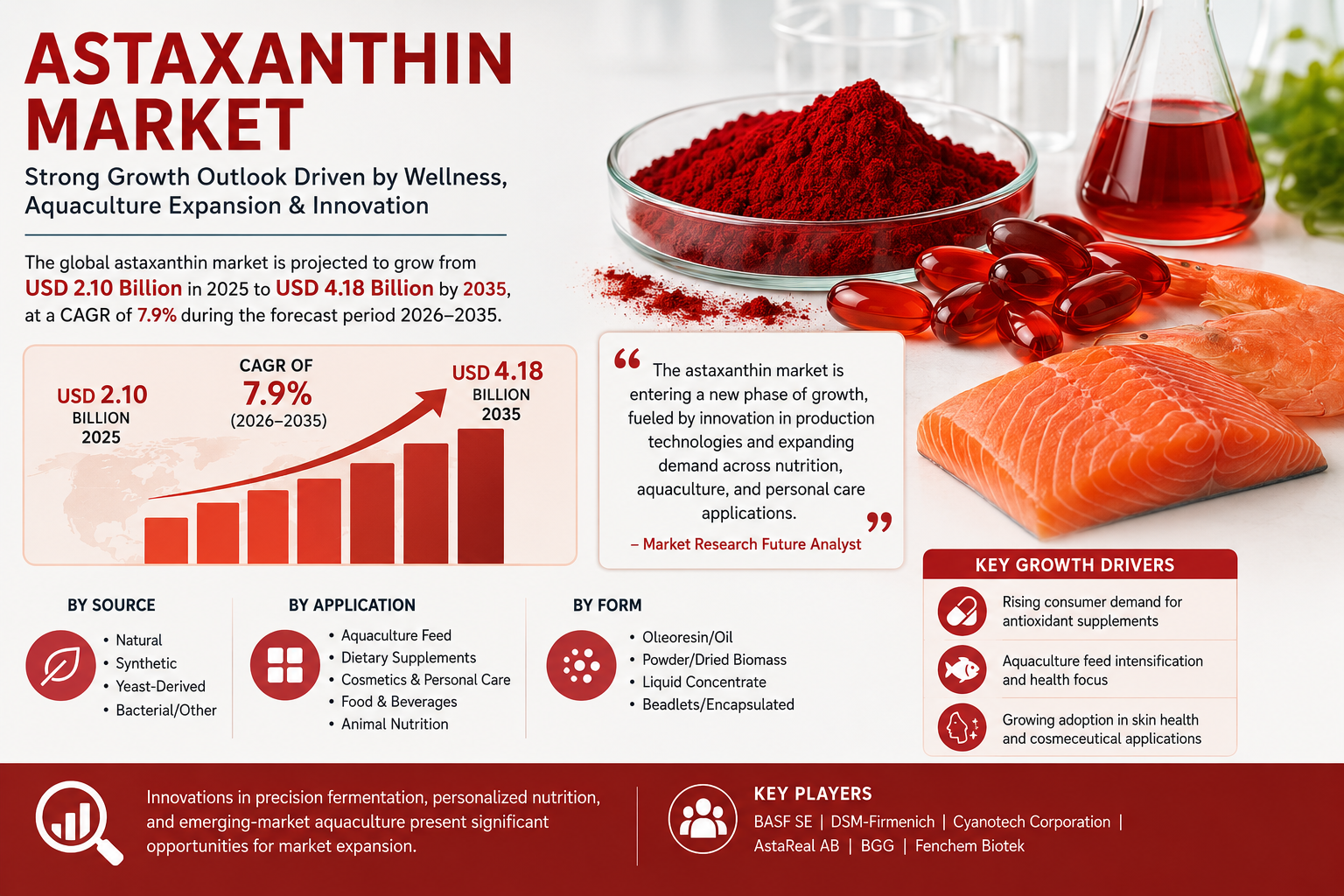
Astaxanthin market
Market Research Future report highlights natural-source innovation, precision fermentation, and emerging-market growth as major opportunities through 2035
The astaxanthin market is entering a new phase of growth, fueled by innovation in production technologies and expanding demand across nutrition, aquaculture, and personal care applications.”
NEW YORK, NY, UNITED STATES, July 8, 2026 /EINPresswire.com/ -- The global astaxanthin market is projected to grow from USD 2.10 billion in 2025 to USD 4.18 billion by 2035, expanding at a compound annual growth rate (CAGR) of 7.9% during the forecast period of 2026 to 2035, according to Market Research Future. Growth in the market is being supported by increasing consumer interest in antioxidant-rich wellness products, expanding use of astaxanthin in aquaculture feed, and rising adoption across cosmetics, personal care, and nutraceutical applications.— Market Research Future (MRFR)
Astaxanthin, a naturally occurring carotenoid known for its powerful antioxidant properties, is gaining broader commercial attention as manufacturers, formulators, and brand owners increasingly position it as a high-value ingredient in health, beauty, and animal nutrition markets. Demand is being reinforced by the shift toward preventive wellness, the search for functional ingredients with differentiated benefits, and the growing need for feed additives that support aquatic animal health, growth, and performance.
The market is also benefiting from innovations in production and delivery formats. Natural sources continue to attract strong consumer preference, while synthetic, yeast-derived, and bacterial or other production pathways are helping suppliers diversify capacity and improve scalability. At the same time, form innovations such as beadlets, encapsulated products, powders, oils, and liquid concentrates are broadening the range of end-use possibilities across food and beverage, dietary supplement, aquaculture, and cosmetic formulations.
Rising Demand Across Nutraceutical and Wellness Applications
One of the strongest growth engines for the astaxanthin market is the rapid expansion of the dietary supplements category. Consumers are increasingly looking for ingredients associated with oxidative stress reduction, healthy aging, immune support, and everyday wellness. Astaxanthin has gained a reputation as a premium antioxidant ingredient, and that perception is supporting its adoption in capsules, softgels, powders, and functional formulations.
The ingredient’s appeal is especially strong among consumers seeking targeted wellness solutions. The growing popularity of personalized nutrition and direct-to-consumer supplement channels is making it easier for premium ingredient brands to reach health-conscious buyers. Manufacturers are responding by developing cleaner-label, high-purity, and easy-to-consume formulations designed to align with modern supplement purchasing behavior. This is helping astaxanthin move beyond niche positioning and into broader consumer wellness portfolios.
At the same time, astaxanthin is being positioned in skin health and cosmeceutical products, where antioxidant performance is closely linked to consumer interest in appearance, aging, and daily skin protection. Beauty-from-within products and topical formulations alike are benefiting from the ingredient’s association with premium wellness, which is helping to expand the market beyond traditional supplement channels and into more lifestyle-oriented product categories.
Get Full PDF Sample Copy of Report: (Including Full TOC, List of Tables & Figures, Chart) @ https://www.marketresearchfuture.com/sample_request/4833
Aquaculture Feed Remains a Major Commercial Driver
Aquaculture feed remains one of the most important application areas in the astaxanthin market. The ingredient plays an essential role in fish and shrimp farming, where it is used to support pigmentation, health, and product quality. As global aquaculture production intensifies, demand for feed additives that can support animal performance and marketable appearance is expected to remain strong.
The increase in aquaculture intensity is particularly significant in emerging markets, where seafood production continues to expand to meet rising protein demand. Feed manufacturers are increasingly incorporating astaxanthin as part of broader nutrition strategies aimed at improving operational efficiency and output quality. This is creating a steady commercial base for both natural and synthetic astaxanthin suppliers, while also encouraging innovation in feed formulation and ingredient delivery.
In addition to pigmentation benefits, astaxanthin is also being recognized for its broader functional value in animal nutrition. That is helping the ingredient gain relevance in diversified feed formulations and increasing its role in high-performance aquaculture systems. As producers seek ingredients that can support both biological performance and commercial value, astaxanthin is expected to remain a key additive in the aquaculture supply chain.
Natural and Next-Generation Production Technologies Are Gaining Momentum
By source, the astaxanthin market includes natural, synthetic, yeast-derived, and bacterial or other production pathways. Natural astaxanthin remains especially attractive to consumers and premium brands due to its clean-label positioning and association with wellness-focused product claims. However, the market is also witnessing strong innovation in production technology, especially through precision fermentation and next-generation manufacturing methods.
Precision fermentation is emerging as a significant opportunity because it can improve production consistency, scalability, and sustainability while supporting ingredient purity. This is particularly relevant for companies looking to serve nutraceutical, cosmetic, and functional food markets where quality expectations are high. As companies work to reduce supply chain complexity and improve production economics, alternative production methods are becoming more important in long-term market strategy. These technologies may also help reduce dependence on traditional extraction pathways and improve resilience across the value chain.
Yeast-derived and bacterial/other sources are also gaining attention as suppliers look to diversify their production portfolios and reduce dependence on a limited set of raw material inputs. These developments may help the market better serve both high-volume industrial applications and premium consumer-facing products. Over time, the ability to balance natural positioning with scalable production is likely to become a defining factor in competitive success.
Cosmetics and Personal Care Expand the Ingredient’s Reach
Although dietary supplements and aquaculture feed remain key demand centers, the cosmetics and personal care segment is becoming increasingly important for astaxanthin manufacturers. Consumer interest in ingredients associated with anti-aging, radiance, hydration support, and antioxidant protection is helping to create stronger demand in beauty applications.
Astaxanthin is well suited to this trend because it can be incorporated into creams, serums, oils, and beauty supplements marketed for skin wellness. The ingredient’s association with premium positioning also makes it attractive for brands seeking to differentiate in crowded beauty categories. As consumers increasingly look for multifunctional products that bridge nutrition and appearance, astaxanthin is expected to maintain growing relevance in cosmeceutical product development. This is especially true in premium beauty segments where ingredient storytelling and performance claims play a major role in purchase decisions.
Food and beverage applications are also expected to contribute to future growth, particularly as functional product innovation expands. While adoption in this segment may be more selective than in supplements or feed, the rising interest in bioactive ingredients and fortified products is creating room for measured expansion. Manufacturers that can address stability, taste, and formulation challenges may find additional opportunities in beverages, nutrition bars, and other functional formats.
Market Segmentation Supports Broad Commercial Adoption
The astaxanthin market is segmented by source, application, and form, reflecting the ingredient’s wide commercial flexibility.
By source, natural astaxanthin continues to attract premium demand, while synthetic and fermentation-based alternatives support broader manufacturing requirements. Natural products are especially important in dietary supplements, cosmetics, and premium wellness products, where clean-label positioning and consumer trust are central to product success. Yeast-derived and bacterial or other production routes are gaining traction as manufacturers look for scalable, high-purity, and more sustainable supply options that can support both premium and industrial demand.
By application, aquaculture feed remains a leading category, followed by dietary supplements, cosmetics and personal care, food and beverages, and animal nutrition. Aquaculture continues to be a major demand center because astaxanthin supports pigmentation, health, and product quality in fish and shrimp farming, while dietary supplements are benefiting from rising consumer interest in antioxidant-rich ingredients, preventive wellness, and healthy aging. Cosmetics and personal care are also expanding as brands incorporate astaxanthin into anti-aging and skin-health formulations, and food and beverage applications are gradually increasing as functional ingredient adoption grows.
By form, oleoresin/oil, powder/dried biomass, liquid concentrate, and beadlets/encapsulated formats each serve distinct processing and end-use requirements. Beadlets and encapsulated forms are widely used in supplements and fortified foods for improved stability and handling, while oils and liquid concentrates are preferred in formulations requiring dispersion or bioavailability. Powder and dried biomass formats support manufacturing flexibility across feed, nutraceutical, and cosmetic applications, helping suppliers address a wider range of commercial and technical needs.
This variety of formats allows manufacturers to tailor astaxanthin for specific product development needs. Beadlets and encapsulated forms are especially useful in supplement and food applications where stability and ease of handling matter. Oils and liquid concentrates are valuable in formulations requiring dispersion or high bioavailability. Powders and dried biomass support manufacturing efficiency in multiple application environments and give formulators more options when designing products for different markets and regulatory environments.
Regional Growth Outlook Remains Broad-Based
The astaxanthin market is expected to see broad-based growth across major regions, with demand supported by health and wellness consumption patterns, aquaculture expansion, and ingredient innovation. North America remains an important market for dietary supplements and premium health products, while Europe continues to show strong interest in clean-label and functional ingredient applications.
Asia-Pacific is expected to be a particularly important growth region due to the scale of aquaculture activity, growing middle-class health spending, and expanding manufacturing capacity. The region’s role in both production and consumption is likely to remain central to long-term market development. Strong seafood production, rising consumer awareness of wellness ingredients, and the presence of ingredient manufacturers are all expected to support regional momentum.
Latin America and the Middle East & Africa may also present emerging opportunities as consumer awareness, feed demand, and industrial applications continue to expand. In these regions, growth is likely to be supported by increasing interest in nutritional products, broader adoption of aquaculture practices, and the gradual development of premium health and beauty categories. As distribution networks improve and ingredient awareness rises, these markets may become more important contributors to global demand.
Competitive Landscape Led by Established Ingredient Companies
The global astaxanthin market includes several established players with strong manufacturing, distribution, and formulation capabilities. Key players identified in the market include BASF SE, DSM-Firmenich, Cyanotech Corporation, AstaReal AB, BGG, and Fenchem Biotek.
Competition in the market is shaped by product quality, source differentiation, production scalability, and application-specific expertise. Leading companies are investing in innovation, supply reliability, and formulation support to strengthen their positions across premium supplement, feed, and cosmetic channels. As sustainability, traceability, and clean-label expectations continue to rise, suppliers with robust technical capabilities and diversified production platforms are likely to gain a competitive advantage.
Strategic emphasis on next-generation production is also expected to influence competition. Companies that can improve cost efficiency while maintaining quality and purity standards may be well positioned to capture growing demand across both mature and emerging application areas. Partnerships, capacity expansion, and technology-driven production improvements are likely to remain important strategic themes over the forecast period.
Opportunities Ahead in Precision Fermentation and Direct-to-Consumer Channels
Looking ahead, the astaxanthin market is expected to benefit from several important opportunities. Precision fermentation offers a pathway toward more scalable and potentially more sustainable production. Personalized nutrition and direct-to-consumer channels are expanding market reach in supplements. Meanwhile, emerging-market aquaculture growth is creating a steady demand base for feed-grade astaxanthin.
Together, these trends suggest that the market is entering a new phase of development in which scientific positioning, production innovation, and commercial diversification will play increasingly important roles. Companies that can balance consumer demand for natural and premium ingredients with the need for scalable, reliable manufacturing are likely to see stronger long-term results. The ability to serve multiple end-use sectors with differentiated product formats may also become a key competitive advantage.
As the market continues to evolve, astaxanthin is expected to remain one of the more dynamic carotenoid ingredients in the global nutrition and wellness landscape. Its ability to serve multiple industries, from aquaculture to beauty to dietary supplements, gives it a broad and resilient growth profile over the forecast period.
For companies, investors, and product developers, the outlook for astaxanthin remains highly promising. The combination of rising health awareness, expanding feed applications, new production technologies, and premium consumer demand is expected to support sustained market expansion through 2035.
Discover Related Research Reports By Market Research Future:
Pet Dietary Supplements Market
https://www.marketresearchfuture.com/reports/pet-dietary-supplements-market-25536
Fortified Juices Market
https://www.marketresearchfuture.com/reports/fortified-juices-market-3810
Fortified Water Market
https://www.marketresearchfuture.com/reports/fortified-water-market-23992
Sagar Kadam
Market Research Future
+1 628-258-0071
email us here
Legal Disclaimer:
EIN Presswire provides this news content "as is" without warranty of any kind. We do not accept any responsibility or liability for the accuracy, content, images, videos, licenses, completeness, legality, or reliability of the information contained in this article. If you have any complaints or copyright issues related to this article, kindly contact the author above.
